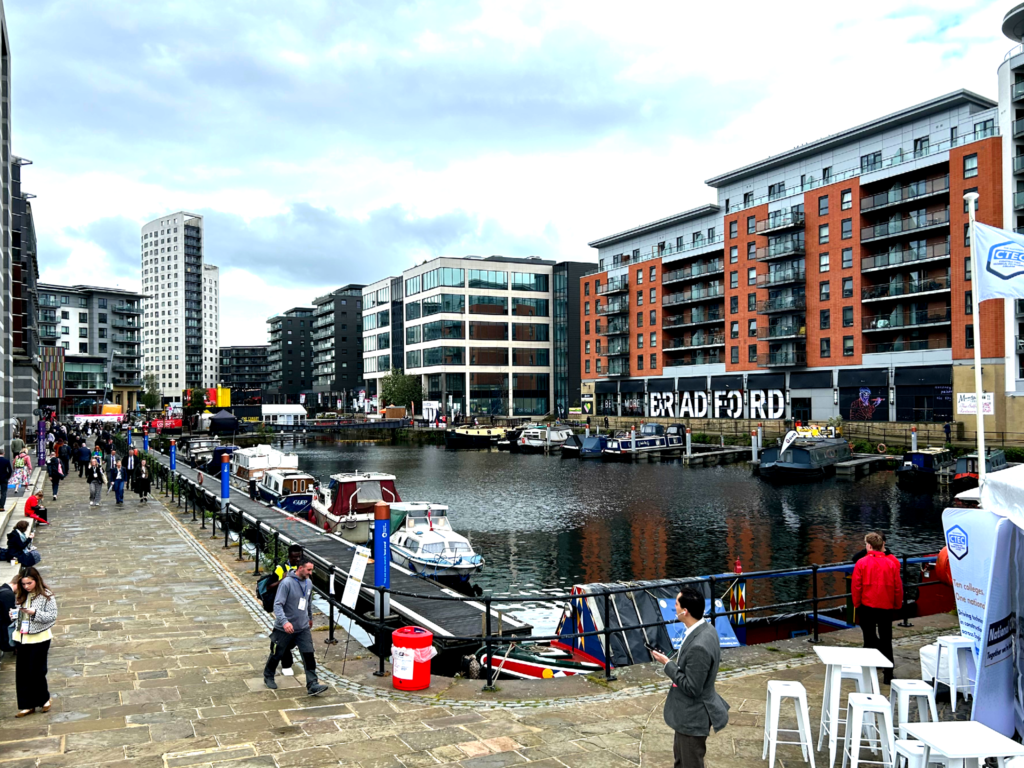
Harlow & Gilston Garden Town Director Paula Hirst attended UKREiiF (UK Real Estate Investment and Infrastructure Forum) last month and, in this blog for HGGT, reflects on what the three-day event at Leeds Dock revealed about delivering homes at scale.
UKREiiF in Leeds isn’t so much a conference as a yearly temperature check, three days that show where the country really stands on delivering housing and infrastructure at scale.
This year, the reading was encouraging.
Momentum is building behind delivery, and there is a sharper awareness of how garden communities, alongside the Government’s New Towns programme, can contribute to that effort.
For Harlow and Gilston Garden Town, the timing of the conversation could not have been more apt.
As I travelled to Leeds, vital transport infrastructure has just started on the ground at the Central River Stort Crossing, and the building of homes at Gilston has gone from planning to reality, as we move on from securing consents to delivery.
That made the framing of last month’s discussions feel particularly resonant.
Across multiple sessions, a familiar set of conditions kept coming up for delivering high-quality development at scale: strong local place leadership; an infrastructure-first approach; proactive coordination across local authority and administrative boundaries; partnership working across public and private sectors; and a shared agenda and ambition locally and nationally, supported by the right resources and governance.
Hearing those conditions named by leaders from across the country was a useful reminder.
Harlow and Gilston spans three district and two county boundaries, which makes coordination harder than it sounds on paper.
We have invested years in the partnership architecture that makes joint working possible, and it is reassuring to know that others understand the importance of this, and to know that this effort is paying dividends now.
The first roundtable I joined, hosted by Newmark and Ashurst and provocatively titled ‘Scream if you want to go faster’, set out to ask which planning reform measures would most accelerate delivery.
The conclusion was striking.
While planning reform matters, there are now other factors better placed to speed things up, and the forward funding of strategic infrastructure was the one that kept resurfacing.
This is familiar territory because the mismatch between when infrastructure costs are incurred and when development revenue flows is a structural feature of garden communities, not a defect of any scheme.
Public sector intervention to bridge that gap is what unlocks scale, and the Government’s Housing Infrastructure Grant at Gilston, which is enabling our first 10,000 homes and will in time be repaid into a revolving infrastructure fund, is a working example of how that intervention can be designed to recycle value back into delivery.
There is hope that the new housing bank and other government-backed instruments will help here, and across the week the room agreed that an infrastructure-first approach is the right one.
The second session, hosted by OPDC and Ebbsfleet Development Corporation, looked at how different delivery vehicles and development corporations are functioning across the country.
Every place is unique, but the challenges of joined-up delivery on complex sites rhyme strongly.
One body with appropriate resourcing and authority to lead change consistently emerged as the most effective shape for delivery at pace and scale.
Harlow and Gilston has a forthcoming Independent Review, and this conversation was timely.
As we move into delivery mode, considering whether any aspects of our governance need to evolve is exactly the right question to ask, and to ask now rather than later.
On Wednesday morning (May 20), the LGA and Essex County Council hosted a discussion on unlocking patient capital to build homes and communities, bringing together investors and local authority leaders.
What struck me here was how decisive individual place leadership is to securing long-term investment.
The investors in the room described partnerships that evolve in places where there is a ‘can-do’ culture, an alignment of interests, and a willingness on all sides to problem-solve until the deal works.
There was useful discussion about whether some form of national framework could help these conversations happen more consistently and I will follow that debate closely.
In the meantime, Harlow and Gilston is ready to enter direct dialogue with those investing patient capital, to explore together how enabling infrastructure can drive development forward.
The final session of the week, hosted by Arup, brought local authority leaders together to discuss the second ‘I’ of UKREiiF: Infrastructure.
Many places share Harlow and Gilston’s infrastructure-first ambitions and face the same forward funding challenges.
Development contributions are essential, but the mismatch between cost and revenue timing often requires public intervention to bridge.
One attendee is developing a new place-based business case that takes advantage of updated Treasury Green Book guidance and its greater focus on wider benefits.
This is an area which we will also follow closely.
Methodology that properly captures the value created by infrastructure investment could shift the funding conversation for places like ours.
Across four roundtables and dozens of informal exchanges in Leeds, the picture was consistent.
The will to deliver is there and the conditions for it are increasingly understood.
What is needed now is the willingness, on all sides, public and private, to act on what we know works.
At Harlow and Gilston, we are ready. Our partnership architecture is in place, planning policy is in place, and delivery is underway.
To colleagues at Homes England and MHCLG, we look forward to continuing our discussions about how the partnership we have built can evolve to continue to contribute to the wider housing programme.
To investors looking for places to deploy patient capital, the same applies.
The foundations at Harlow and Gilston are firm, and we welcome the conversation.